STEM just got airborne — and a little bit smarter!
Welcome to the future of school science projects, where robots can follow lines, drones avoid walls, and sensors turn cardboard prototypes into intelligent, cloud-connected machines. Whether you’re a teacher, student, or just someone who accidentally made a drone do a backflip indoors — this guide to the best IoT sensors for school robotics and drone projects is for you.
Why Use IoT Sensors in Robotics & Drones?
Sensors are like a robot’s eyes, ears, and reflexes. They help your projects:

- Avoid obstacles
- Follow commands
- Track environmental data
- Connect to the cloud for automation & alerts
Perfect for:
- IoT-based school science projects
- STEM learning with garden robots, delivery drones, or rover bots
- DIY automation and AI-based drone challenges
Best IoT Sensors for Robotics & Drone School Projects
Here’s a list of classroom-friendly, budget-approved sensors that bring serious brainpower to your bot builds:
1. Ultrasonic Sensor (HC-SR04)
Purpose: Distance measurement / obstacle avoidance
How it works: Sends sound waves and calculates how long they take to bounce back.
Use it in:
- Drones that avoid walls
- Robots that stop before bumping into teachers
Fun classroom demo:
Build a robot that plays “laser tag” using ultrasonic sensors to detect range!
2. Infrared (IR) Sensor
Purpose: Line following, proximity detection
How it works: Emits infrared light and measures reflections.
Use it in:
- Line-following robots
- Maze-solving bots
- Basic gesture detection
Experiment idea:
Create a robot that follows black tape around the classroom like a puppy!
3. Accelerometer + Gyroscope (MPU6050)
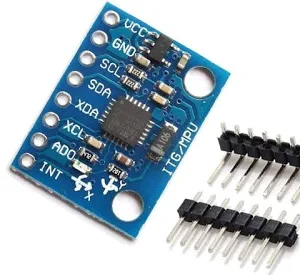
Purpose: Orientation, tilt, balance detection
How it works: Measures angular velocity and acceleration.
Use it in:
- Stabilizing drones
- Tilt-based robot control
- Crash detection systems
Cool project:
Design a drone that self-corrects its angle mid-flight — or a bot that says “Ow!” when it tips over.
4. Barometric Pressure Sensor (BMP180/BME280) 
Purpose: Altitude and weather data
How it works: Measures atmospheric pressure to estimate height.
Use it in:
- Drones that measure elevation
- Weather-reporting robots
- Automated school weather stations
Experiment:
Send a drone up and log its altitude in real-time to an IoT platform like ThingSpeak!
5. GPS Module (Neo-6M)
Purpose: Location tracking
How it works: Uses satellite data to determine real-time coordinates.
Use it in:
- Autonomous delivery drones
- Tracking bots
- Location-aware security systems
Try this:
Attach it to a robot and log its movement path in real time using Adafruit IO or Blynk!
6. Gas / Air Quality Sensor (MQ-135)
Purpose: Detects pollution or gas leaks
How it works: Changes resistance when exposed to gases like CO2, NH3, etc.
Use it in:
- Environmental drones
- Indoor air monitoring robots
- Smart garden bots that monitor air quality
Classroom idea:
Fly a drone around the schoolyard to detect air quality differences between playground and parking lot.
7. Camera Module + AI (ESP32-CAM / Pi Camera)
Purpose: Visual recognition
How it works: Captures images and video — use with AI to detect objects.
Use it in:
- AI-powered obstacle detection
- QR code navigation
- Facial/object recognition bots
Advanced project:
Build a robot that identifies classroom objects or reads signs using machine learning!
Pair These Sensors With…
- Microcontrollers: Arduino, ESP32, Raspberry Pi
- Cloud platforms: Blynk, ThingSpeak, Arduino Cloud, Adafruit IO
- Simulators: Tinkercad (basic logic), Wokwi (more realistic with ESP32)
Classroom-Friendly Robotics & Drone Challenges
- Obstacle Course Showdown
– Robots race through a maze using ultrasonic + IR sensors - “Mission: Environment” Drone Flight
– Drones use GPS + gas sensors to track pollution - Smart Delivery Bot
– Line-following robot + barcode scanner + buzzer = mini Amazon - Data Dash
– Students build bots that send live data (altitude, temp, motion) to a dashboard
Teacher Tips
- Start with simulations if you don’t have hardware yet
- Pair tech with real-world problems (sustainability, pollution, farming)
- Encourage teamwork: Coding + wiring + design = full STEM experience
- Use free platforms like Wokwi or Tinkercad to teach the logic before building
Final Thoughts: Big Bots, Small Sensors, Giant STEM Potential
IoT sensors are what take a robot or drone from “cute” to “whoa, it can think!” With just a few components, students can build smart, responsive, cloud-connected machines that solve real problems — and look super cool doing it.
Whether you’re exploring smart agriculture, school surveillance bots, or eco-drones, the right sensors make all the difference.
